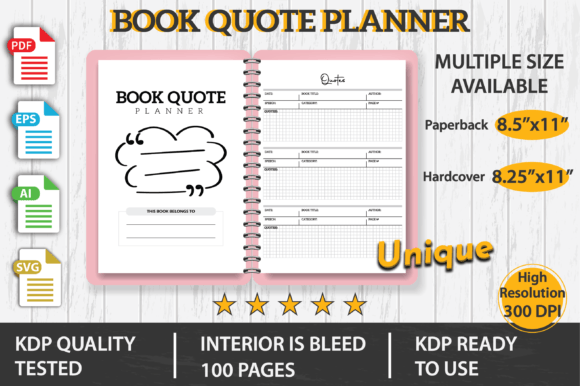
Reviewing the Book Quote Planner for Embroidery Use
As a designer who spends half my life staring at digitized files and the other half watching needles punch through fabric, I have learned to look past the glossy preview images. When I first encountered the Book Quote Planner, listed under Kdp Interiors and categorized as Graphics, my initial reaction was caution. This is not a standard machine embroidery design file with pre-set stitch paths. Instead, it is a high-resolution graphic layout intended for print, specifically described as an 8.5 x 11 inch interior with bleed. However, for the creative entrepreneur, the line between print graphics and embroidery assets is often blurred by ingenuity. The question is not whether this is a drag-and-drop embroidery file, but whether its visual structure holds up when translated into thread.
The Aesthetic First Impression
The mood of the Book Quote Planner is distinctly literary and organized. It carries a professional, clean aesthetic that appeals to readers, writers, and stationery lovers. Visually, it relies on strong typography and structured layouts rather than complex illustrations. For an embroidery designer, this is both a blessing and a challenge. Text-based designs require precision. There is no hiding behind dense fill stitch patterns or intricate applique design layers. The clarity of the message depends entirely on the legibility of the letters and the spacing between elements.
When I imagine this graphic adapted for a handmade product, I see it working best on items that benefit from a minimalist, intellectual vibe. Think of a canvas tote bag design for a local library fundraiser, or a subtle chest logo on a cozy reading sweatshirt. The professional look suggests it belongs in a boutique setting, not a chaotic craft fair bin. It feels curated. If you are an Etsy seller looking to expand beyond apparel into home decor, this graphic’s structured nature could translate beautifully into a framed hoop art piece, where the "planner" aspect becomes a decorative motif rather than a functional grid.
Real-World Application Scenarios
Let us consider a real-life scenario. A client approaches me for a personalized gift for a book club host. They want something sophisticated, not cutesy. Using the visual elements from the Book Quote Planner, I would isolate a specific quote or header style from the 100-page interior. Translating this to custom apparel, such as a high-quality cotton tee or a linen apron, requires careful digitizing. Since the source is a graphic, I must manually create the stitch path. I would likely use a combination of satin stitch for smaller text to keep edges crisp and a light running stitch for any decorative borders to avoid bulk.
For a small shop product, imagine using these graphical elements on a embroidered patch. Patches are forgiving because they are stitched on stable twill before being applied. The sharp lines of the planner’s typography would stand out well against a contrasting background. This approach allows you to create a line of design assets that feel cohesive. You are not just selling a shirt; you are selling a lifestyle brand centered around reading and organization. This increases the perceived value of the finished product significantly.
Technical Considerations and Limitations
Here is where practical judgment is crucial. Because the Book Quote Planner is originally a print graphic with dimensions like 8.25×11 inches, it contains details that may be too fine for direct embroidery conversion without adjustment. Tiny serifs on fonts can get lost in the fabric texture. If you attempt to stitch this directly onto a stretchy fabric like a jersey knit without proper stabilization, the text may distort. I strongly advise using a cut-away stabilizer for garments that will be washed frequently, such as a sweatshirt embroidery project.
Another critical factor is stitch density. Print graphics do not have density settings. When you digitize this yourself, you must ensure that large solid areas of text do not become too dense, which can cause puckering. On dark fabrics, you will need to pay extra attention to thread colors. A white thread on black cotton is classic, but if the graphic has subtle gray elements, they may disappear. Always test your digitized version on scrap fabric first. Check the contrast. Does the design read clearly from three feet away? If not, simplify the layout.
Be cautious with curved surfaces. Placing a rectangular planner layout on a cap or hat is difficult due to the curvature. The design may warp visually. It is better suited for flat surfaces like tote bags, pillow covers, or kitchen towels. For baby embroidery, ensure that any digitized version uses soft threads and avoids scratchy backing materials, as the original graphic’s sharp lines might translate to stiff stitching if not handled with care.
Commercial Viability and Branding
For commercial embroidery projects, consistency is key. The Book Quote Planner offers a unique, professional design language that can help build brand recognition. If you are creating a line of holiday embroidery gifts for teachers or librarians, this theme fits perfectly. It feels thoughtful and specific. However, since this is listed as a KDP interior graphic, you must verify the licensing terms. Can you use these graphical elements to create digital embroidery files for sale? Or only finished physical goods? Never assume. Check the license before listing anything on your store.
Using this graphic as a base for printable mockup previews can also boost your sales. Show customers what the embroidered version could look like on a tote or a journal cover. This bridges the gap between the digital Graphics category and the tangible world of handmade crafts. It helps buyers visualize the end result, increasing trust and engagement.
Final Designer Notes
To summarize, the Book Quote Planner is not a ready-to-stitch digital embroidery file. It is a rich visual resource that requires a skilled hand to translate into thread. Its strength lies in its typographic clarity and professional layout. To succeed:
- Digitize carefully: Convert the graphic elements into stitch data, paying attention to letter spacing and stroke width.
- Test extensively: Run tests on various fabric textures, from canvas to cotton, to check for puckering or thread breaks.
- Check licensing: Confirm you have the right to use the graphic for commercial craft business purposes.
- Simplify if needed: Remove tiny details that will not survive the washing machine.
- Contrast is king: Ensure your thread color stands out against the fabric background.
If you treat this graphic as a design inspiration rather than a direct template, it can elevate your embroidery project portfolio. It offers a sophisticated angle for small business merchandise that stands out in a market saturated with generic quotes. With the right technical execution, the Book Quote Planner can become a cornerstone of a refined, literary-themed collection.