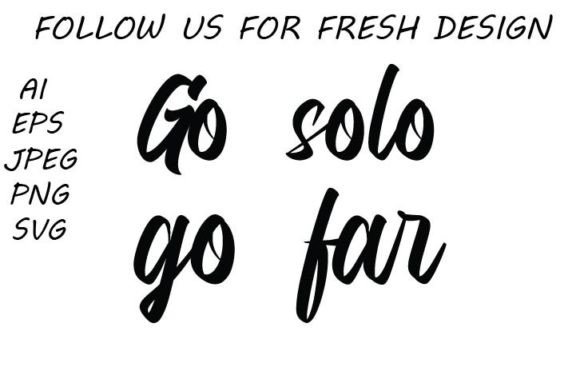
Reviewing the GO Solo Go Fat. Embroidery Design
As a designer who has spent years digitizing patterns and testing them on everything from delicate silk to heavy denim, I approach every new machine embroidery design with a mix of curiosity and skepticism. We have all been there: downloading a file that looks crisp on the screen but turns into a tangled mess of thread breaks and puckering on the fabric. Recently, I took a close look at GO Solo Go Fat. Solo Traveling Quote, a typography-based vector illustration marketed primarily under T-Shirt Designs and Graphics. While the listing describes it as a digital product for instant download, my focus was strictly on how this design translates from a flat vector into a tangible, stitched reality.
First Impressions and Visual Personality
The immediate appeal of GO Solo Go Fat. Solo Traveling Quote lies in its bold, unapologetic attitude. It is not a subtle, whisper-quiet motif; it is a statement piece. The typography drives the visual narrative, relying on strong letterforms rather than intricate pictorial elements. For an embroidery project, this is often a double-edged sword. Text-heavy designs require precise digitizing to ensure legibility, especially when scaled down. However, the confidence of the layout suggests it is intended for larger applications where the message can breathe.
The mood is playful yet empowering, tapping into the growing trend of solo travel and body positivity. This thematic resonance makes it a strong candidate for custom apparel aimed at a modern, adventurous demographic. When I visualize this stitched out, I do not see it as a delicate accent on a handkerchief. Instead, I see it anchored firmly on the back of a heavyweight hoodie or centered on a canvas tote bag design. The visual weight of the words demands a sturdy substrate to support the structural integrity of the stitches.
Real-World Application: The Tote Bag Test
To evaluate the practical viability of this design, I imagined a specific real-life scenario: creating a line of merchandise for a boutique travel blog. The goal was to produce a durable, stylish handmade product that customers would actually use on their trips. I chose a natural cotton canvas tote as the test vehicle. Canvas is forgiving, providing a stable base that minimizes the risk of distortion, which is crucial for typography.
In this context, GO Solo Go Fat. Solo Traveling Quote performs exceptionally well. The bold lines of the letters would likely translate into clean satin stitch borders or dense fill stitch areas, depending on the specific digitizing choices made by the creator. On a tote bag, the design becomes a conversation starter. It moves beyond mere decoration to become part of the user’s identity. For an Etsy seller or small shop product owner, this kind of emotional connection drives sales. Customers are not just buying a bag; they are buying into the ethos of independent travel and self-acceptance.
Considerations for Apparel and Stretchy Fabrics
While the design shines on stable fabrics like canvas or twill, applying it to custom apparel such as t-shirts or sweatshirts requires more caution. If you are planning to use this on a jersey knit or a stretchy blend, the stitch density becomes a critical factor. Heavy text designs can cause "hoop burn" or puckering if the stabilizer is not chosen carefully. I would recommend using a cut-away stabilizer for garments that will be washed frequently, ensuring the design remains flat and does not distort over time.
For sweatshirt embroidery, the texture of the fleece can sometimes obscure fine details. Since this design relies on typography, you must ensure that the letter spacing is wide enough to prevent the stitches from merging into an illegible blob. A test stitch-out on scrap fabric identical to your final garment is non-negotiable here. Do not skip this step. Check the thread tension and ensure that the thread colors provide sufficient contrast against the fabric background. A dark thread on a dark heather grey sweatshirt might look sophisticated in a printable mockup, but it could vanish in real life.
Navigating Technical Challenges
There are specific scenarios where GO Solo Go Fat. Solo Traveling Quote should be used with care. Small hoop sizes are generally unsuitable for large typographic statements unless the design is significantly scaled down, which risks losing readability. If you attempt to shrink this design for a embroidered patch or a small pocket logo, the internal details of the letters may collapse. Always check the minimum recommended size provided by the digitizer, though since this is sold as a vector illustration converted for embroidery, those specifics might vary.
Additionally, curved surfaces like caps present a challenge. Embroidering large text on a structured cap requires careful hooping and possibly a different digitizing strategy to account for the curve. Without proper adjustment, the text can appear warped. For beginners, I suggest sticking to flat surfaces like pillow covers, tea towels, or aprons before attempting complex curved applications. These items allow you to master the behavior of the design without the added difficulty of three-dimensional shaping.
Enhancing Product Value and Brand Consistency
From a business perspective, the quality of your embroidery directly impacts customer trust. A cleanly stitched GO Solo Go Fat. Solo Traveling Quote signals professionalism. It shows that you understand the mechanics of your craft. For craft business owners, consistency is key. If you offer this design as part of a collection, ensure that the thread palette aligns with your brand identity. Whether you choose vibrant, travel-inspired hues or muted, earthy tones, the execution must be flawless.
This design also holds potential as a personalized gift. Imagine pairing the quote with a custom date or location stitched in a smaller, complementary font below. This adds a layer of exclusivity and makes the item a cherished keepsake rather than just another commodity. For holiday seasons, this could easily transition into a popular holiday embroidery gift for the traveler in your life, provided you market it correctly as a celebration of freedom and adventure.
Practical Designer Notes for Success
Before you commit to producing a batch of items featuring GO Solo Go Fat. Solo Traveling Quote, take these practical steps:
- Test on Scrap Fabric: Always run a test stitch on the exact fabric type you intend to use. This reveals issues with tension, density, and stabilizer compatibility.
- Check Contrast: View your design in black and white. If the text disappears, your color choice lacks sufficient contrast for real-world visibility.
- Verify Licensing: Since this is a digital product, confirm the license terms. Can you sell finished physical items? Are there restrictions on mass production? Clarify this before listing on Etsy or other platforms.
- Inspect Detail Level: Zoom in on the vector file. Are there tiny anchor points or complex curves that might cause needle breaks? Simplify if necessary.
- Use Proper Stabilizer: Match your stabilizer to your fabric. Tear-away for stable woven fabrics, cut-away for knits, and wash-away for delicate or sheer materials.
In conclusion, GO Solo Go Fat. Solo Traveling Quote is a potent design asset when used with intention and technical precision. It is not a one-size-fits-all solution, but for the right project—such as a sturdy tote, a cozy sweatshirt, or a bold statement piece—it offers significant commercial and creative value. By respecting the limitations of the medium and prioritizing quality execution, you can transform this digital file into a standout finished product that resonates with your audience.